

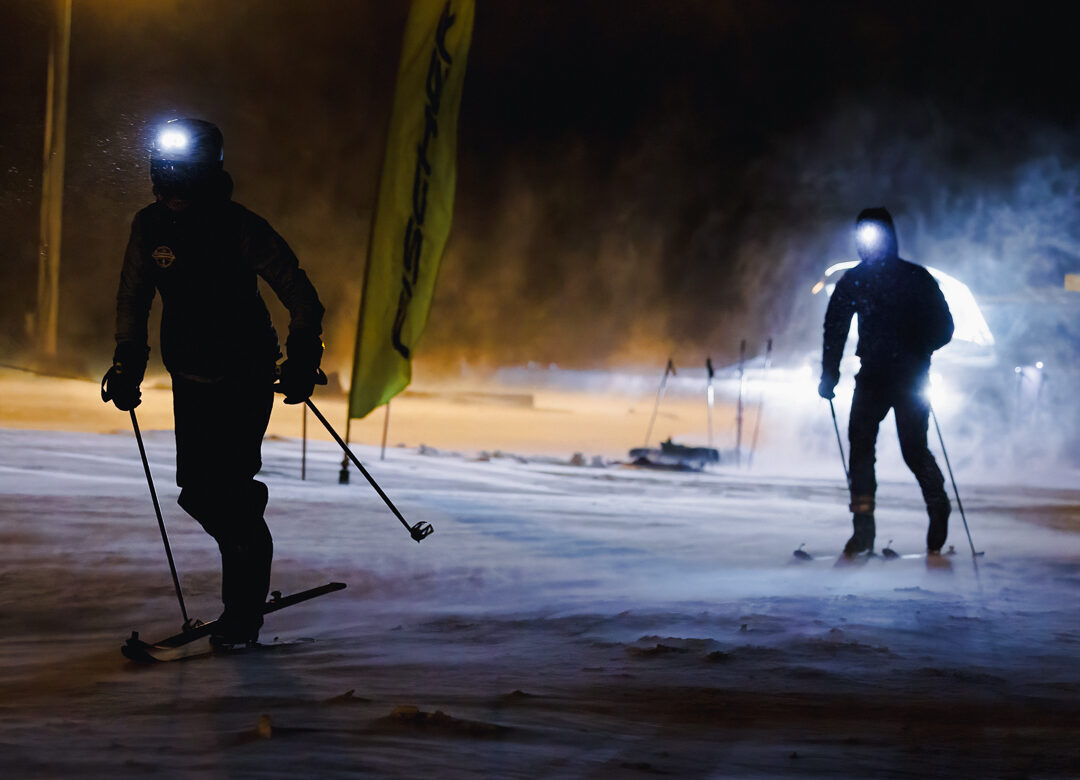
Last Skier Standing is a ski version of a backyard ultra that challenges skiers to climb up and ski down a slope every hour until just one skier is left.
By Nate Weitzer
“It would be awesome to make sunrise,” one skier said to another as we skinned through the nordic track at the base of Black Mountain in Rumford, Maine. We were preparing to head up the Allagash Trail for the ninth time since Last Skier Standing 2026 began at 10 a.m. Friday, February 6.
“Let’s not get ahead of ourselves,” came the quick reply.
It was just after 7 p.m. Temperatures had dipped quickly into the low teens, and the chatter and excitement of early afternoon laps shifted to a rhythmic chorus of swooshing skins on hard-packed powder in relative silence as we steeled ourselves to the task ahead.
That exchange encapsulated the dichotomy I felt throughout most of my effort at the seventh annual endurance event held each February by White Mountain Ski Company. Last Skier Standing has a simple set of rules: Start skinning every hour, on the hour, reach the transition point about 1,150 feet above the base area, and ski back down in time to start again.

With 125 people competing, the quarter-mile nordic track provides a warm-up to thin out the herds, and gives racers a chance to hand off jackets or grab last-minute fuel from their support crew before heading up.
To reach my prospective goal of 24 hours, the plan was to stay present, to hopefully reach a feeling of relatively comfortable stasis in which I was unaware of how many laps we had completed, or how many hours we were from sunrise.
But at LSS, the best laid plans of skiers and crew often go awry.
Intense foot pain from an issue I had going into the race (Morton’s neuromas) forced me to switch out of the ultralight La Sportiva boots and Dynafit skis I spent the past year financing and dialing in. Rocking a heavier touring set-up, my nutrition started to dive, and by 8 p.m. I was spiraling. Dragging my skis upwards in the dark each hour, I tried to think of anything other than how many laps I could muster before tapping out. Then, everything changed.
My wife, Erin Polich, a longtime volunteer at these events, joined me for the 10 p.m. lap, and WMSC employee Jacob Husby decided to sprint ski up and down the nordic track blasting pump-up jams, while light snow began to fall. A shift in fueling strategy brought life back to my legs and I stopped counting the laps, even forgetting the time for a bit.

“It’s Friday night! Let’s go!” the designated hype man screamed as he blared “Sandstorm,” by Darude out of a bluetooth speaker.
And that was the reminder of another strategic trope I emphasized while training for my first effort at LSS: “We don’t HAVE to do this, we GET to do this.” It’s a privilege to ski. Having enough fitness to ski uphill is a privilege. And the opportunity to ski up and down a resort for days on end, surrounded by a supportive community, friends who love you enough to sleep in 30-minute bursts before catering to your every need, and the safety net of a dedicated and welcoming mountain operations squad? That’s an honor.
Several participants added to that sentiment by doing laps for charity. Professional skier Brody Levin, the 2022 finisher, returned to raise money for Protect our Winters. Former women’s record holder at LSS, Hilary McCloy, raised funds for Wasatch Adaptive Sports in collaboration with her nephew, Drake Becker, a sit skier in Utah with Cerebral Palsy. Zach McCarthy raised money for Inclusive Ski Touring, and Zbigniew Grabowski ran a fundraiser in partnership with IST for the deaf community, inspired by his daughter, Oona, who was born deaf and blind, yet loves to ski.
Sure, there were highs and lows throughout my night on course. My swollen pinky toes threatened to burst and trench foot was starting to form on either sole. I bonked from another calorie deficit, and spent a couple laps with trailing comrades, scattered in a silent but determined pod like a school of fish looking to evade predatory fatigue.

As we rounded the track after 6 a.m., realizing I would indeed make it through dawn created an unexpected flood of emotion. Now I can better understand why people return to LSS and other endurance events year after year to meet adversity with different tools, because it brings something out of you that everyday life rarely provides. I’ve done hard things in the mountains before, been out in the wilderness for 20-plus hours with no safety net, but for me, those experiences bolstered a sense of confidence in isolation. At Black Mountain that night, I felt empowered by the collective.
I nearly timed out on Lap 21, crossing the start/finish line with about four minutes to spare, but my crew got the skins back on, filled me with calories and caffeine, and I slogged off into the morning snow three more times, always at the back of the pack, always digging for motivation while digging into my pockets for energy gels to keep my mitochondria functioning.
Cresting the final climbs on those laps, each participant ahead of me offered encouragement or clicks of their poles as they started to ski back down. They could assuredly tell I was running on fumes in pursuit of a goal, and soon they would be as well. We were no longer just faces in the crowd. We were commiserating cohorts.
“You’ll need a goal beyond 24 hours,” my friend Mark Manganiello told me in the weeks leading up to LSS, “Because when I did 24 last year, my body just shut down after that.”
Yet after sliding across the finish line at 9:55 a.m. and collapsing in a barefoot wreck at my aid station, there were absolutely no regrets about calling it. The pursuit of perfection will always be imperfect, but getting pushed toward my limit by the support of people I loved felt about as close as it gets.

Nate Weitzer is an avid trail runner, backcountry skier, and mountain climber living in North Woodstock, New Hampshire, where he writes for multiple publications. Over the past 20 years he’s thru-hiked the Appalachian Trail, a portion of the Pacific Crest Trail, climbed Mt. Rainier, Adams, Baker, Hood, and skied off multiple volcanoes. Weitzer has summitted the NH 48 in all four seasons, finished the ADK 46er list while working trail maintenance in the Keene Valley area, and completed the Colorado 14ers over the course of four summers. He’s written about the inaugural White Mountains 100 and ultrarunner Lexi Jackson for Northeast Explorer.