


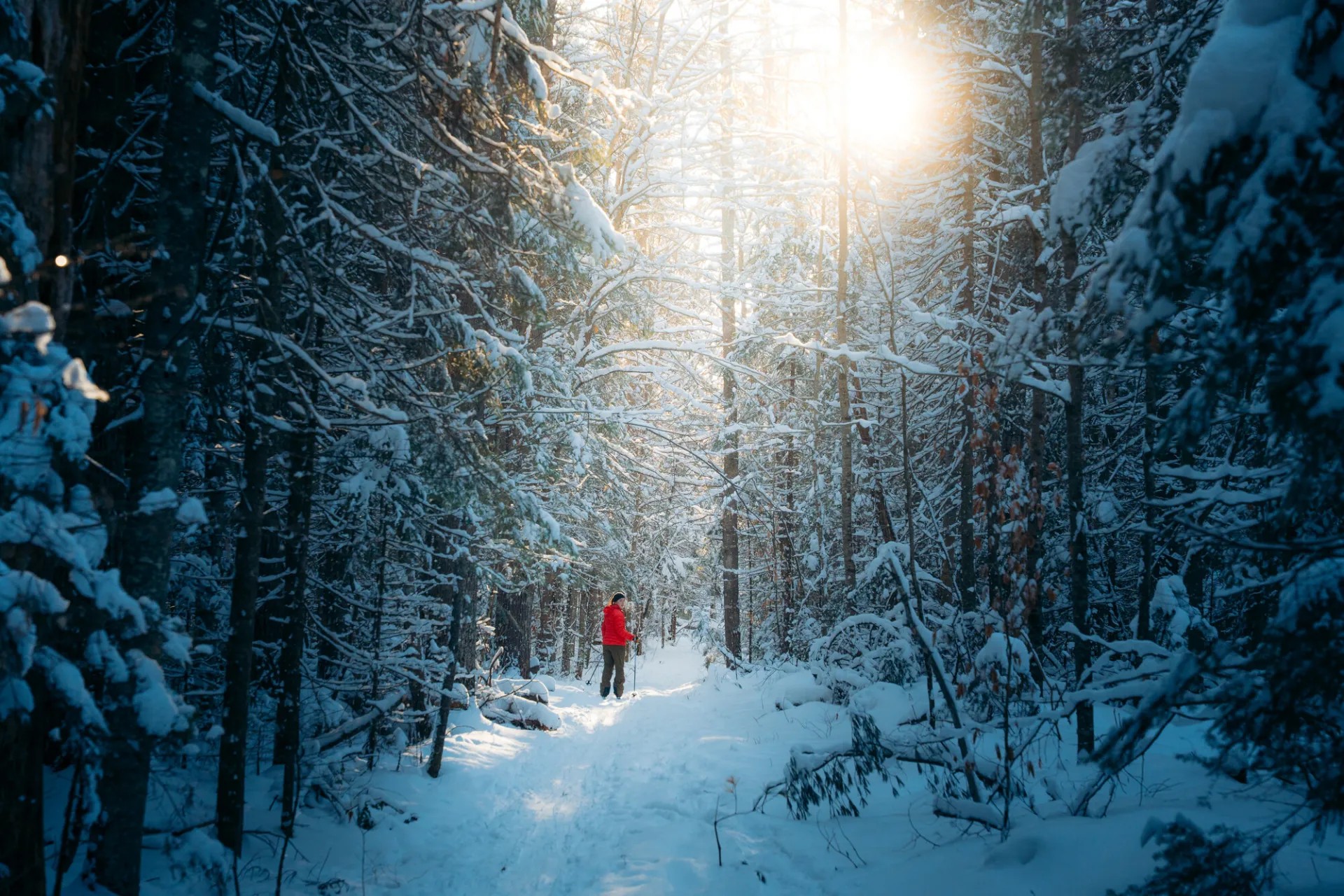
When the snow falls in the Northeast, some of the region’s best hikes take on an entirely different character. And some might say that they become even better.
Gone are the bugs, crowds, and oppressive heat. In their place is a white, glittering world of ice and snow, and vast stretches of powdery wilderness that offer quiet and solitude.
The Northeast has lots of snowshoeing opportunities to choose from, whether you’re looking for a relatively easy outing or a challenging mountain adventure. Here are 14 Northeast snowshoe hikes to put on your bucket list.
(Any backcountry travel in winter presents very real dangers. Do your research, make sure you’re prepared, and try not to end up in a search and rescue report.)

Mount Jo – New York
The open summit of Mount Jo provides one of the best views in the Adirondack High Peaks. And when the region is covered in snow, that view is even better. Mount Jo stands 2,876 feet and is a good option for those who might be new to snowshoeing in the mountains. With two trails to the summit, it’s easy to make this a loop hike. But while snowshoes will suffice for most of it, snow spikes might be needed on the Short Trail’s steepest sections.
Champney Falls – New Hampshire
While this is one of the most popular summertime hikes in the White Mountains, come winter you’ll still see other people, but not nearly as many. Hike nearly three miles to Champney Falls, which in winter become beautiful, frozen walls of ice. If you want, continue on another nearly five miles (and 1,700 feet of elevation) to enjoy the view from Mount Chocorua.
Mount Moosalamoo – Vermont
This long trek – 7.7 miles round-trip – will challenge your endurance. It features brook crossings, lots of woods, climbing and a steep descent. But from the top of 2,640-foot Moosalamoo are great views of the lake-dotted area below.
Chimney Pond – Maine
One of the most difficult, remote snowshoeing adventures in New England, it’s a two-day trek to the pond, which sits at the foot of Mount Katahdin. You need to plan months in advance to stay in the bunkhouse or lean-tos, but the amazing scenery and dramatic wilderness are worth it.
Ricketts Glen State Park – Pennsylvania
One of the most beautiful places in Pennsylvania, Ricketts Glen State Park is home to 22 named waterfalls – including 94-foot Ganoga Falls – that look downright magical when they freeze in winter. The park is also home to old growth timber, 245-acre Lake Jean, and a diverse collection of wildlife. Hike the Falls Trail System to explore the Glens, home to free-flowing waterfalls cascading through rock-strewn clefts in the hillside.

Cascade Mountain – New York
At 4,098 feet, Cascade Mountain in the Adirondack High Peaks is a serious winter hike and you should only tackle it if you have prior winter hiking experience. If you don’t yet have that experience, it’s worth working toward. Cascade provides stunning panoramic views from its rocky summit. Snowshoes will work for most of the trek, but you should carry microspikes or crampons in case they’re needed on steep, icy sections. Expect the temperature to drop near the top and strong winds on the open summit.
Mount Greylock – Massachusetts
During the summer and early fall, crowds often overwhelm Massachusetts’ highest peak, where people can drive to the summit. But in the winter, you can often feel like you are alone. Take the Gould Trail on the east side of Greylock. At the summit, you’ll enjoy the views of the valleys to the west and surrounding Berkshire Hills.
Ramapo Mountain State Forest – New Jersey
With rugged terrain and elevation jumping from 200 to 1,100 feet, Ramapo Mountain State Forest offers some challenging trails close to New York City. The forest has 9 trails, ranging from 1 mile in length to nearly 10 miles, and all but one of them is rated “difficult” by the New Jersey Parks and Forest Service. Some of the trails offer a view of the New York City skyline.

Arethusa Falls – New Hampshire
Arethusa Falls in Crawford Notch State Park provides visitors with stunning scenery in both summer and winter. At roughly 160 feet tall, it is the tallest single-drop waterfall in New Hampshire. In winter, it freezes over into a dramatic tower of thick ice. The hike to the falls on the Arethusa Falls Trail is roughly a mile-and-a-half (three miles out-and-back), with about 900 feet of elevation gain.
Caribou Mountain – Maine
This difficult trail through the dense pine forests of the Caribou-Speckled Mountain Wilderness tops out on the summit of 2,850-foot Caribou Mountain, straddling the Maine-New Hampshire border. The trip is 5.4 miles round-trip, and has a long, steady elevation gain of nearly 2,000 feet, but the views from the summit are breathtaking.
Golden Eagle Trail – Pennsylvania
The Golden Eagle Trail is roughly 9-mile circuit trail features rugged terrain, interesting rock formations and remnants of old logging camps. It also features wonderful views of the Pine Creek Valley. Also nearby is the 3-mile, out-and-back Bob Webber Trail, a strenuous short hike with great views from the top of the south mountain of Wolf Run.

Burnt Mountain – Vermont
In the state’s Northeast Kingdom, remote Burnt Mountain Preserve features a steep, strenuous shoe to the top of its 2,800-foot peak. The trail is 4.6 miles round trip, and you likely won’t see any crowds. But you will enjoy the views at its bare peak, from which on a clear day you can see Mount Mansfield and Lake Champlain.
Slide Mountain Wilderness – New York
With more than 47,000 acres, the Slide Mountain Wilderness is the largest wilderness area in the Catskills. You can access the area’s remote interior using one of the many trails that wind through this forest. Or, if you feel like striking off on your own, the Slide Mountain Wilderness also has an expansive trailless area that really takes you into the wilderness. To enjoy a peak that has inspired poets, climb Slide Mountain, the tallest peak in the Catskills.
Mount Monadnock – New Hampshire
It seems almost every New Englander has climbed Monadnock. But in winter? The steep White Cross Trail is a challenging climb, and beware of the dangerous icy sections near the top. But on a clear day, the view from the summit is one of the very best in the Northeast.