


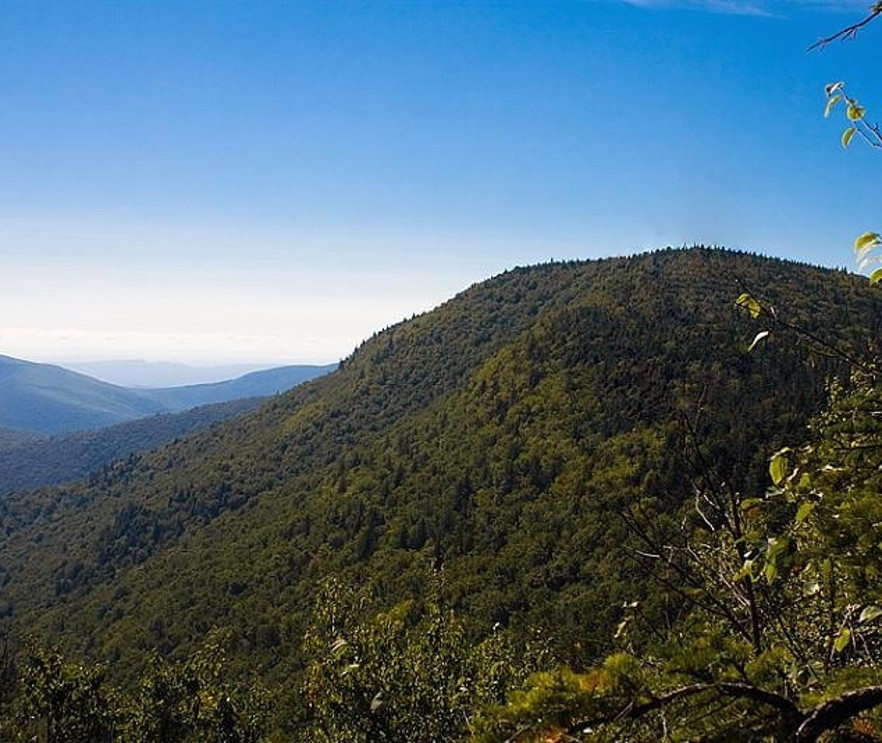
The Slide Mountain Wilderness isn’t just the largest wilderness area in New York‘s Catskill Forest Preserve, it is also arguably its most rewarding.
With more than 47,500 acres of rugged mountains, dense forests, remote streams, and some of the most iconic summits in the Catskills, the Slide Mountain Wilderness is one of the Northeast’s premier hiking and backcountry camping destinations.
At its heart stands Slide Mountain, the tallest peak in the Catskills at 4,180 feet. Alongside neighboring summits such as Wittenberg, Cornell, Panther, Peekamoose, and Table mountains, it forms a network of trails that draw hikers from across the Northeast seeking sweeping views, challenging climbs, and a true backcountry experience.

Hiking Highlights
The wilderness contains roughly 35 miles of trails, all reserved exclusively for hiking, helping preserve the area’s quiet wilderness character.
Slide Mountain
For many visitors, the primary goal is reaching the summit of Slide Mountain. The most direct route begins at the Slide Mountain Trailhead on Oliverea Road and follows the Phoenicia East Branch Trail before joining the Burroughs Range Trail for the final climb. The route covers 5.4 miles round trip and gains approximately 1,780 feet in elevation.
While the summit itself is mostly wooded, hikers are rewarded with a sense of standing atop the highest point in the Catskills. A plaque honoring famed naturalist John Burroughs marks the summit area, commemorating his deep connection to the mountain.
Giant Ledge
Arguably the most popular viewpoint in the Catskills, Giant Ledge offers dramatic cliff-top panoramas overlooking Woodland Valley and the surrounding mountains. The hike is relatively short—just 3.2 miles round trip with roughly 1,100 feet of elevation gain—making it one of the most accessible scenic hikes in the region.
Sunrise and sunset are particularly spectacular from the ledges, where multiple rocky viewpoints provide unobstructed vistas.
The Burroughs Range
Experienced hikers seeking a challenge should consider the Wittenberg-Cornell-Slide Trail, often referred to as the Burroughs Range Trail. This demanding route traverses three of the Catskills’ most famous peaks—Wittenberg, Cornell, and Slide—over nearly 10 miles and more than 3,600 feet of elevation gain.
The trail includes steep scrambles, exposed ledges, and some of the finest summit views in the Catskills. Many hikers regard the Wittenberg overlook as one of the most beautiful viewpoints in New York State.
Panther, Peekamoose, and Table Mountains
Those looking to escape the crowds can venture deeper into the wilderness. The Giant Ledge-Panther Mountain Trail continues beyond Giant Ledge to Panther Mountain, where traffic drops significantly. Further south, the Peekamoose-Table Mountain Trail offers a more remote experience, winding through old-growth forest, historic stone walls, and occasional viewpoints.

Backpacking and Camping
Slide Mountain Wilderness is one of the premier backpacking destinations in the Northeast. The wilderness contains 24 designated primitive campsites and three lean-tos scattered throughout the trail network. Campsites can be found near the Burroughs Range, Giant Ledge, Peekamoose and Table mountains, the West Branch Neversink River, and other backcountry locations.
Lean-tos are located near Fox Hollow, Terrace Mountain, and Table Mountain, providing simple shelter for overnight travelers.
In addition to designated sites, primitive camping is permitted throughout much of the wilderness.
Many backpackers choose to spend a night along the Burroughs Range, creating a multi-day trip that links Slide, Cornell, and Wittenberg mountains. Experienced hikers frequently describe the range as one of the most rewarding backpacking routes in the Catskills, with several backcountry campsites located between Slide and Cornell mountains.
Winter Adventures
Although best known for summer and fall hiking, come winter, Slide Mountain Wilderness transforms into a snowy backcountry landscape ideal for snowshoeing and cross-country skiing. All hiking trails are open to winter recreation.
Winter hikers frequently encounter snow and ice near the higher elevations, and local hikers consistently recommend carrying traction devices and appropriate winter gear, particularly on Slide Mountain and the Burroughs Range.
Planning Your Adventure
The most popular access points include the Slide Mountain Trailhead on Oliverea Road, the Giant Ledge Trailhead, Woodland Valley Campground, Fox Hollow Road, and Denning Road. Because Slide Mountain Wilderness is among the most visited areas in the Catskills, parking lots can fill quickly on weekends, especially during peak foliage season. Midweek visits often provide a quieter experience.