


By Dan Mathers
“Fear is the mind-killer.” – Frank Herbert, Dune
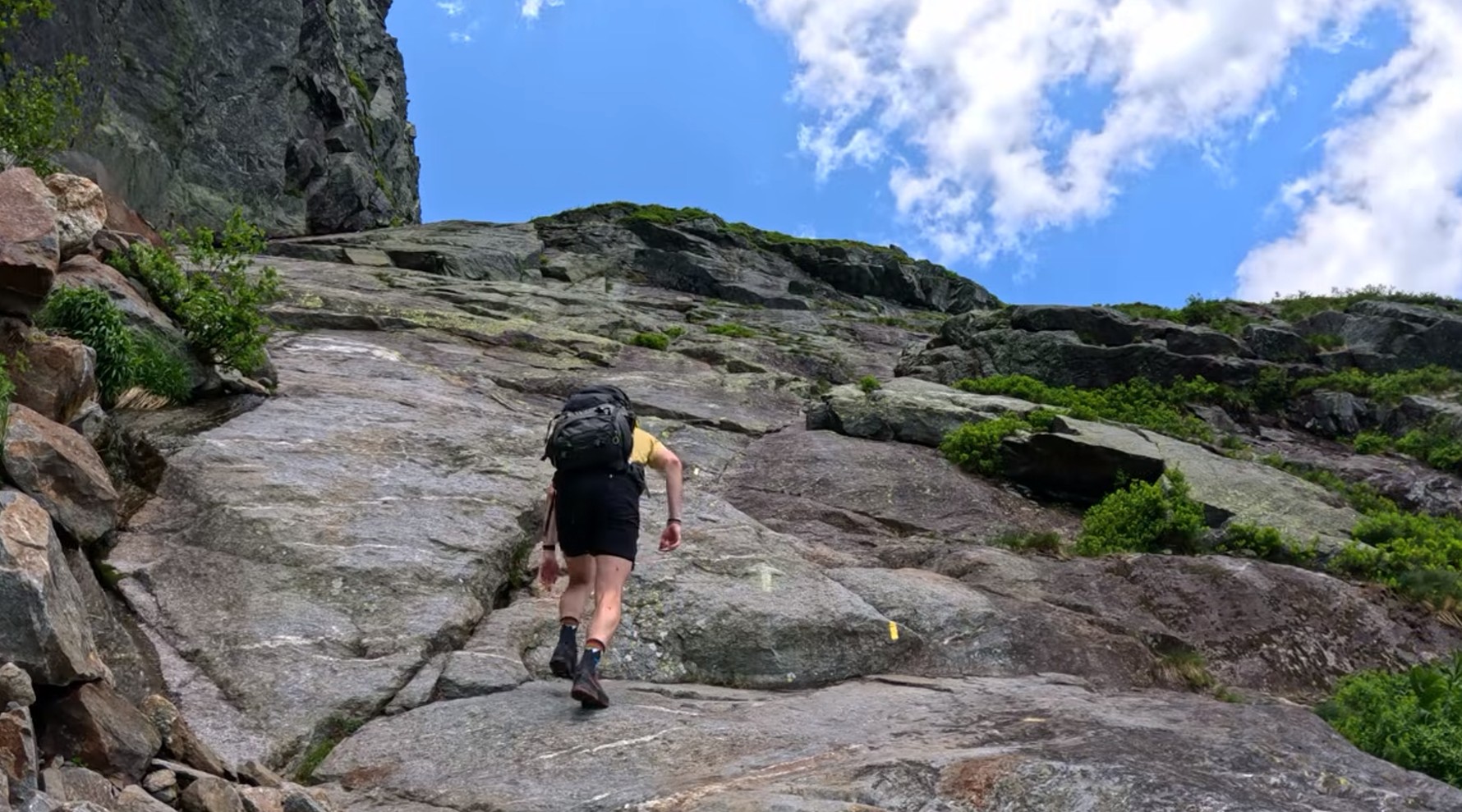
They’re the kind of trail features that will force a hiker’s breath to quicken and their knees to tremble. Terrain that can turn a hike that had sounded fun into something that suddenly seems like a bad idea: steep, rocky scrambles; sketchy ladder climbs; prolonged exposure; sheer drop-offs.
Having these features on a trail can test a hiker’s resolve or make them avoid a route altogether. But some hikers seek out this kind of thrill, like theme park junkies who flock to the fastest, scariest rollercoasters.
For those who crave the pulse-pounding rush of a frightening hike, there’s a list for that: The Terrifying 25.

While some hiking lists challenge hikers to summit peaks over 4,000 feet or direct hikers toward places with spectacular views, the Terrifying 25 is the Northeast’s hiking horror genre.
Created in 2015 by hiker Patricia Ellis Herr and her daughters, Alexandra and Sage, the Terrifying 25 is a collection of trails in New Hampshire’s White Mountains chosen specifically for their rock scrambles, steep ledges, ladders, slides, caves and other features that make a hike more interesting—and, often, considerably more intimidating—than an average walk in the woods.
And, like a Hitchcock movie, it even has mindbending twists you probably didn’t see coming:
Despite the name, it actually isn’t a list of 25 trails.
(Cue the dramatic music: Dun-dun-DUN!)
The Terrifying 25 actually consists of 20 required trails, plus five additional trails selected from a list of 14 possible candidates. Hikers who complete 25 trails can submit their list and receive a Terrifying 25 finisher patch.
Unlike a lot of hiking lists, the object here isn’t necessarily to bag summits. Often, it’s the trail itself that is the attraction.

Trails Of Terror
According to the Terrifying 25 website, the Herr family originally created the list for their own amusement. Sage came up with the name, Alexandra designed the patch, and Patricia combed through the White Mountain Guide looking for hiking trails with descriptions of the kind of rock scrambling and cave exploration the family enjoyed. Patricia also sought input from other hikers, and eventually hiked every trail herself.
In her description of the list on the website, Patricia is very clear this list is not for beginners, and safety should take priority over completing the list.
“If you are new to hiking, or even if you have hiked elsewhere but are new to White Mountain hiking, then I strongly suggest you wait until you have a different White Mountain list under your belt before starting this one,” says Patricia. “The most important part of each hike is not to finish the trail. It’s to return safely to your car. When in doubt, go home.”
Below is a look at the Terrifying 25’s 20 required trails and 14 elective trails. You can learn more at the Terrifying 25 website.

The 20 Required Trails
- Baldface Circle Trail – Features ledge scrambles, unobstructed views, and few crowds because it doesn’t hit a 4,000-footer. Lots of exposure.
- Caps Ridge Trail – It’s “just” 2.5 miles one way up Mount Jefferson. But it as 2,700 feet of climbing and lots of rock scrambles.
- Carter Ledge Trail – On the northeast side of Mount Chocorua, most of the ledges on this trail aren’t bad, but one ledge is very steep.
- Castle Trail – Another trail on Mount Jefferson, this 5-mile hike has 4,200 feet of elevation gain.
- Chemin des Dames – This climb between Mount Adams and Mount Madison is just under half a mile, but has 800 feet of elevation and very steep scrambles.
- Flume Slide Trail – At 3.3 miles with 2,500 feet of elevation gain, this trail features a long (often wet) slab. Descending this trail is a bad idea.
- Great Gulf Trail – A long, strenuous climb up Mount Washington, and the trail can be hard to follow on the headwall.
- Great Gully Trail – Steep, rough scrambles await hikers on this one-mile climb out of King Ravine near Mount Adams.
- Huntington Ravine Trail – Arguably the most difficult, dangerous hike in the White Mountains. After a June 2026 rescue, New Hampshire Fish and Game officials said it shouldn’t even be listed as a hiking trail. Check out a film of what it’s like to climb the Huntington Ravine Trail here.
- Ice Gulch Path – Just under a mile long, this trail climbs 700 feet and has lots of boulders and crevices that require scrambling.
- King Ravine Trail – A scenic but steep climb up the headwall on Mount Adams. It is just over three miles with 2,700 feet of elevation gain.
- Madison Gulf Trail – A steep, exposed climb up Mount Madison.
- Mount Morgan Trail (ladder hike) – This hike requires scrambling up several ledges, navigating a boulder cave, and climbing three ladders.
- Mount Percival Trail (boulder cave) – This trail has hikers climb through caves and scramble up boulders. It can be combined with the Mount Morgan Trail for a fun loop (and a good way to knock off two trails in one hike).
- North Slide – One of the toughest trails on this list, hikers tackle a steep, exposed climb up North Tripyramid. Along the way it gains 1,200 feet in half a mile.
- Six Husbands Trail – This trail up Mount Jefferson has it all, with caves, challenging scrambling, and steep climbs up ladders. Do not descend this trail.
- South Slide – The route on South Tripyramid can be combined with the North Slide for a fun, but challenging loop. It’s not as steep as the North Slide, but lots of loose rock make it tough.
- Sphinx Trail – A steep, difficult trail with ledge scrambles that connects the Great Gulf Trail to the Gulfside Trail.
- Subway (King Ravine Trail) – This short path off the King Ravine Trail is easy to underestimate, but its difficult rock scrambling and boulder caves require more time than most hikers expect.
- Table Rock Climbing Trail – A short 0.3-mile hike in Dixville Notch with 600 feet of climbing, this steep trails has rocky ledges and sheer dropoffs at the top.
The 14 Elective Trails
- Air Line Trail – A 4.3-mile trail up Mount Adams with 4,500 feet of elevation gain.
- Algonquin Trail – A remote trail up Sandwich Dome with rough, steep terrain.
- Beaver Brook Trail – A steep stretch of the Appalachian Trail up Moosilauke.
- Brook Trail – Fun scrambling on the south side of Chocorua.
- Blueberry Ledge Trail – While much of the trail isn’t too scary, it features a few ledges to climb near the top of Mount Whiteface.
- Castle Ravine Trail – Scrambles and loose rock on Mount Jefferson.
- Desolation Trail – A steep, difficult climb up Mount Carrigain.
- Devil’s Hopyard – This hike makes the list for its wet, slippery boulders.
- Goodrich Rock Trail – Most of this hike isn’t bad, but a climb up a near-vertical 20-foot ladder on a boulder nets it a spot on this list.
- Hi-Cannon Trail – The hike on Cannon Mountain features a climb up a wooden ladder.
- Osseo Trail – Features a series of steep, wooden ladders on Mount Flume.
- Percy Peaks Trail – Located on remote North Percy Peak, it requires scrambling on ledges near the summit.
- Wildcat Ridge Trail – An intimidating stretch of the Appalachian Trail with steep ledges, a chimney, a ladder, and climbs over rock and wood steps.
- Willey Range Trail – This steep trail on Mount Willey is just over a mile long with 1,650 feet of elevation gain and features a series of near-vertical wooden ladders.